


 Buy tickets
 Buy tickets
Artwork of the month December 2024
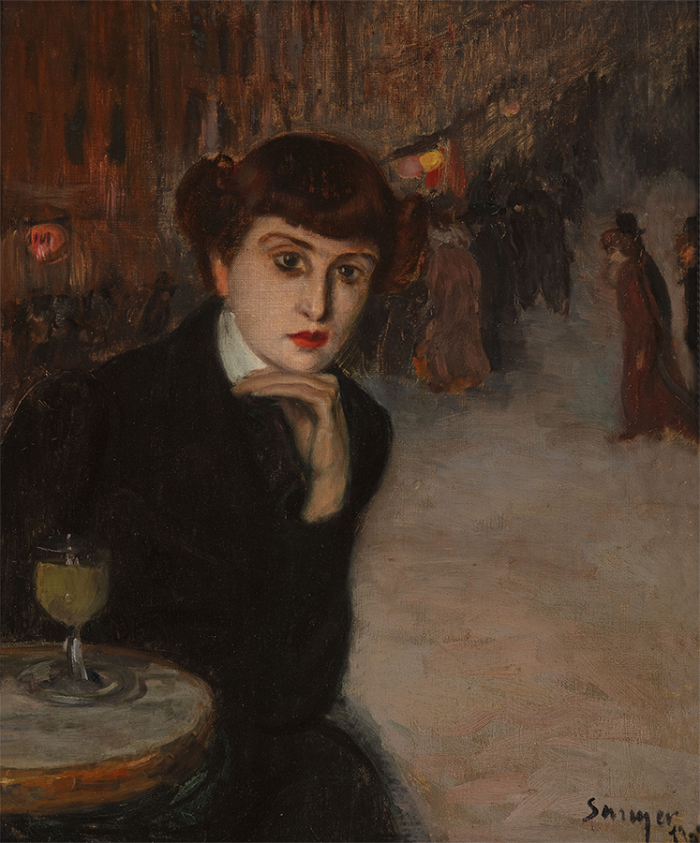
Artwork: Dona en un cafè [Mujer en un café], de Joaquim Sunyer i de Miró (Sitges, 1874-1956)
Place / Date: París, 1900
Material / Tecnic: Pintura al óleo sobre tela
Sizes: 58 x 49 cm / 80 x 73 cm (marc)
Collection: Museu de Maricel, Sitges. Dipòsits externs, núm. inv. 92
Joaquim Sunyer y de Miró, son of the master craftsman Jaume Sunyer y Juncosa (Torredembarra, 1874 - Sitges, 1918) and Rosa de Miró y Argenter (Reus, 1850 - Sitges, 1896) began painting at the shelter of the painters luministas de la playa y de las huertas del sandy Sitgetano, training in which his maternal uncle, the luminist painter Joaquim de Miró y Argenter (Sitges, 1849-1914) played a decisive role.
When the family moved to Barcelona due to his father's work, the young Sunyer enrolled in the Escuela de Bellas Artes de Lonja in the course 1894-1895, where he made friends with Joaquim Torres-Garcia, Isidre Nonell, Joaquim Mir and Ricard Canals . With them, members of the so-called Colla del Safrà due to the predominance of yellowish tones in their works, he frequented popular environments, practiced street drawing and plein-air painting.
In his forays into Sitges, he went out to paint orchards and landscapes often accompanied by his uncle. He took part in the Barcelona Fine Arts exhibitions of 1894 and 1896, where his works were commented on by the most important art critic of the time, Raimon Casellas, as examples of the Luminist School.
The attraction of Paris as the capital of the arts that offered the young people of his generation artistic and personal freedom and opportunities to exercise the life of an artist was the lure that led him to ask his father for the money destined for his redemption from military service, that at that time he supposed to go to war in Cuba. The death of his mother in the summer of 1896 precipitated his departure, which was as a refugee.
During the two first years in Paris, Sunyer experienced a life of black bohemia. Installed in Montparnasse, he went through all sorts of hardships, subsisting on the basis of selling drawings and works on paper, since he could hardly pay for pictorial material. The first work he sold was of a miserabilist theme, typical of his condition; it represented a seated old man and the acquisition by dr. Landau, who became his first collector.
In 1898 he moved to Montmartre on foot, carrying a cart with his few belongings while muttering poems by Charles Baudelaire. Immersed in a Paris that showed him the harshest face, embodied in the humble people and the most needy popular classes that he so well got to know, he managed to ensure that his engravings and pastels found a place between the salons of Beaux Arts and the market of art
The engravings with which he illustrated the work of the poet Jehan Rictus, Les soliloquies du pauvre (1897), began to change his fortune, although he continued his
miserabilist vision until the turn of the century. Two books of
the Paris Minutes collection, in which he illustrated the texts of Henry Fèvre (1901) and Gustave Geffroy (1903), show his deep knowledge of Parisian environments and streets, a characteristic that was recognized by the critics of the time.
Always in search of a language of his own, Sunyer's settings were the boulevards and streets, such as those of Belleville and Montmartre; the gardens of the Palau del
Luxembourg, close to the Latin quarter, the interiors of the cafes and the world of entertainment, mainly the Moulin Rouge. The protagonists of his works are the people of the street, the marginalized, the poor, workers and simple people, the students and passavolantes who frequent the gardens of Luxembourg, and the women of the boulevards, streets and places of recreation. He generally depicts group scenes, but he devotes his attention to specific types, such as old vagrants and street vendors, and to female figures that he singles out for some reason.
Around 1903, Sunyer was recognized as a good artist, with a production of works on paper that placed him among the best of the moment. In 1905, his merchant Henry Barbazanges financed a trip to Spain so that he could delve deeper into the genre of la españolada, a Paris clientele style of those years practiced by, among others, Anglada-Camarasa, Ricard Canals and Pau Roig. On his way to and from Madrid, Toledo and Ávila, Sunyer stopped in Sitges to see his family. Later, settled again in Paris, he painted some Spanish works to his merchant's taste, but returned to female figures and urban landscapes far from the marginal city.
The stay in Sitges and the contemplation of the exhibitions that the Salón de Automne dedicated to Gauguin (1906)
and Cézanne (1907) determined a radical turn in his production, reorienting it towards a landscape primitivism evident in the works carried out in Sitges from 1908. In 1909 he ended his Parisian stage and began the course towards the plastic Novecentismo, movement of what is the most important representative. As he wrote in one of his letters evoking Paris, "il faut faire la jeunesse", but in reality it meant his passage through the modern life that the city offered him.
The painting Woman in a Café was painted in Paris in 1900. Its protagonist shares with the bleacher the fact of being the two first women singularized in the artist's work.
The laundress represents the woman of humble origin who earns a living doing laundry for others, characterized by carrying a bag of clothes all over Paris – in Belleville, on the Canal Saint Martin, on the rue des Abesses or on the rue Lepic– between 1898 and 1903.
La mujer del café appears between 1899 and 1901 located in friendly settings such as the Luxembourg gardens and boulevards and elegant places. He stars in an oil painting entitled Món elegante (1901), a concept that evokes concrete meeting and leisure places. Two versions of the same engraving, also from 1901, identify her as Parisian and Mujer en rojo.
It is a vision that reflects a whole lifestyle embodied in the figure of the Parisian woman, as Ramon Casas has enshrined in the pages of Pelo & Pluma on the occasion of her prolonged stay at the Universal Exhibition of 1900. She is a free woman , who leaves the house, walks, frequents singer-cafés and dance shows and who enjoys a freedom and a social position far removed from the women of the popular classes.
The artist always places her in the foreground, half-body or full-body, in an unmistakably arranged position that represents both a portrait and an attitude. The woman in the cafe has remained anonymous, but she was certainly not a simple stranger, although at that time she was the bleacher who lived with the artist who represented her walking through the streets and in the intimacy of the naked.
Basic bibliography
Benet, R. (1975). Sunyer. Barcelona: Polígrafa.
Fèvre, H., & Sunyer, J. (1901). Les Minutes Parisiennes : 5 heures la rue du Croissant. Illustrations de Sunyer. Gravées sur bois par Beltrand et Dété. Paris: Ollendorff.
Geffroy, G., & Sunyer, J. (1903). Les Minutes parisiennes : 7 heures : Belleville. Illustrations de Sunyer gravées sur bois par T.-J. : Beltrand et Dété. Paris: Ollendorff.
Panyella, V. (1997). Joaquim Sunyer. Col. Gent nostra. 117. Barcelona: Columna.
Panyella, V. (1999). «El pintor de la vida moderna (París, 1896-1910)», a: Joaquim Sunyer. La construcció d'una mirada. Barcelona: Museu Nacional d’Art de Catalunya, p. 35-54.
Sindreu Portabella, Roser. (1992). L’obra gravada de Joaquim Sunyer: catàleg raonat. Tesi doctoral, Universitat de Barcelona. Departament de Representació i Anàlisi Compositiva, 1992.
Sunyer Hanappier, I., & Villalba Moreno, J. A. (2024). Joaquim Sunyer, 1874-1956. Catálogo razonado digital. Parte 1a (Vol. 1).
Descàrregues:


