


 Buy tickets
 Buy tickets
Peter Stämpfli, an international figure in pop art and narrative figuration, and closely linked to Sitges, has died.
The Swiss artist died last night in Paris at the age of 88.
Friday 20 February 2026
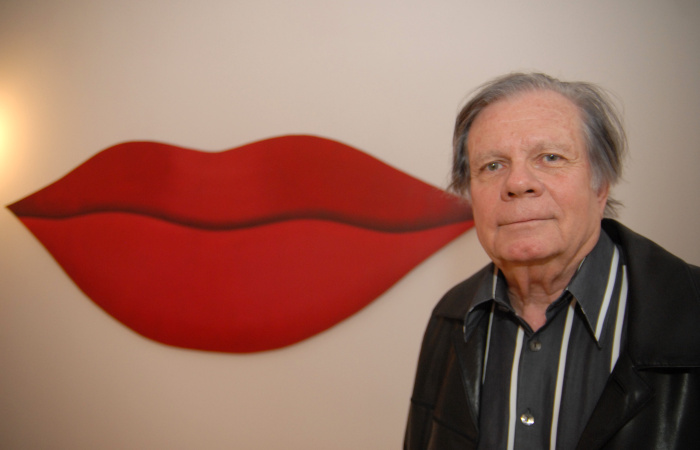
The artist Peter Stämpfli passed away last night in Paris, his adopted city and the center of his creative process, which resonated throughout the world. Born in Deisswil bei Münchenbuchsee, Switzerland, in 1937, Stämpfli was an international figure in Pop Art and narrative figuration. A significant portion of his work is on permanent display at the foundation he established with his wife, Anna Maria, in Sitges, a town to which he maintained close ties.
Peter Stämpfli's name appears in the catalogue of the most important international artists of the second half of the 20th century. He held approximately seventy solo exhibitions in some twenty countries, including major retrospectives at the Centre Pompidou in Paris (1980), Seyne-sur-Mer (1997), the Museum of Art and History in Fribourg (1999), and the Galerie National du Jeu de Peu. He has also participated in some of the most important exhibitions of narrative figuration, such as those held at the Grand Palais and the National Center for Contemporary Art, both in Paris; the Quirinale Palace in Rome; and the IVAM (Valencian Institute of Modern Art) in Valencia. In 1970, he represented Switzerland at the Venice Biennale.
Peter Stämpfli is one of the most prominent Swiss artists. Highly valued and sought after in his home country, France, and the United States, critical acclaim has consistently highlighted his distinctive style and the paths he has explored at different stages of his artistic career. He has explored pop art, narrative figuration, and geometric abstraction, identified by the tire track, which has marked his work from the late 1960s to the present day.
Peter Stämpfli and Sitges. In 1961, Peter Stämpfli married Anna Maria Torelló, from Catalonia, and in 1970 they first visited Sitges. They fell in love with the town and bought their first house on Carrer d’en Bosc—in the heart of the old quarter—which would become their shared residence with Paris and, occasionally, their native Bern. In Sitges, Peter Stämpfli—who spoke fluent Catalan—was always known as “Pere.”
From the very beginning, the Stämpflis became active residents of Sitges and were particularly involved in its cultural life. They promoted local festivals and civic activities that resonated strongly with the community, such as the Carrer Bosc festivities. In 1995, they renovated a building, also on Carrer Bosc, to create a cultural space and the headquarters of the Grup d'Estudis Sitgetans (Sitges Studies Group). In recognition of their connection to and contribution to the town's cultural life, as well as their role in promoting Sitges internationally, the Town Council honored Pere Stämpfli in 2004 as an Adopted Son of the Town.
In 2006, the Stämpfli couple decided to bring to fruition a long-held dream: for Sitges to have a contemporary art collection open to the public. They created a Foundation that bears their name and assembled a collection built solely through donations from internationally renowned artists, all of whom were friends and colleagues.
The Stämpfli Foundation building opened in 2011, thanks to the transfer of the Mercat del Peix (Fish Market) from the City Council. In 2019, the facilities were expanded with the addition of a new, fully renovated building, also on Carrer Bosch. Currently, the Fundació Stämpfli - Art Contemporani (Stämpfli Foundation - Contemporary Art) has six exhibition halls equipped with the necessary facilities of an international exhibition center, a restoration, conservation, and storage facility for works not on public display, a documentation space, and an auditorium. The Stämpfli Foundation is managed by the Consorci del Patrimoni de Sitges (Sitges Heritage Consortium).
The Stämpfli Foundation Collection. The Stämpfli Foundation's collection comprises approximately one hundred works and thirty more on loan, representing 65 renowned artists from twenty different countries, who generously donated their works to the Foundation out of friendship with Peter Stämpfli.
The initial core consists of works by a new generation of artists who, in 1964, moved away from the abstraction and informalism of the 1950s and embraced a new figuration known as Narrative Figuration, which emerged in Paris in 1964 with the exhibition "Mythologies quotidianes" at the Musée des Beaux-Arts.
These were times of social change, when society was embracing the logic of consumption based on the mass production and distribution of goods. A group of young creators harnessed the power of images, ubiquitous through new media such as advertising, film, comics, photography, and television, to forge a new figurative aesthetic.
Artists who make up the Fundació Stämpfli collection: François Arnal, Eduardo Arroyo, Gianni Bertini, Pierrette Bloch, Mark Brusse, Pierre Buraglio, Pol Bury, Rafael Canogar, Tom Carr, Philippe Cazal, Miguel Chevalier, Robert Combas, Carlos Cruz-Díez, Henri Cueco, Marco del Re, Gérard Deschamps, Marc Desgrandchamp, Daniel Dezeuze, Richard di Rosa, François Dufrêne, Erró, Gérard Fromanger, Horacio García – Rossi, Daniel Humair, Christian Jaccard, Claire-Jeanne Jézéquel, Ladislas Kijno, Konrad Klapheck, Peter Klasen, Peter Knapp, Piotr Kowalski, Jean Le Gac, Jean-Jacques Lebel, Jean-Michel Meurice, Bernard Moninot, Jacques Monory, Olivier Mosset, Jean-Luc Parant, Pavlos, Daniel Pommereulle, Markus Raetz, Bernard Rancillac, Jean-Pierre Raynaud, Antonio Recalcati, Jaume Rocamora, Guy de Rougemont, Jean-Michel Sanejouand, Sato Satoru, Antonio Segui, Peter Stämpfli, Takis, Antoni Taulé, Pierre Tilman, Gérard Titus-Carmel, Luis Tomasello, Niele Toroni, Kim Tschang-Yeul, Michel Tyszblat, Vladimir Velickovic, Claude Viallat, Jacques Villeglé, Jan Voss, Michael Warren, Hugh Weiss, Joel-Peter Witkin and A-Sun Wu.


